February 6, 2014

A different vintage

On the same day I found and bought the Harmien's patterns, I found something else: Two pattern magazines which belong to the Frohne system (a system like Lutterloh, with miniature patterns which you have to enlarge using a tool which you used to buy with your first set of patterns. Lutterloh uses a scale ruler, Frohne's is a bit more complicated and resambles a big drawing compass.  I bought a 1950's set of patterns with this tool last year but I still have to try it out), autumn 1971 and winter 1972.
I'll show you the first one in this post.

I don't usually go for 1970's patterns. Just a bit too recent for me. I have a couple of Marion magazines from the decade, but that's it.
I like these though.

Although, 1970's coats are nearly always to my taste. I would definitely wear these.

And the one here on the right.


I'm less sure about the suits and dresses.

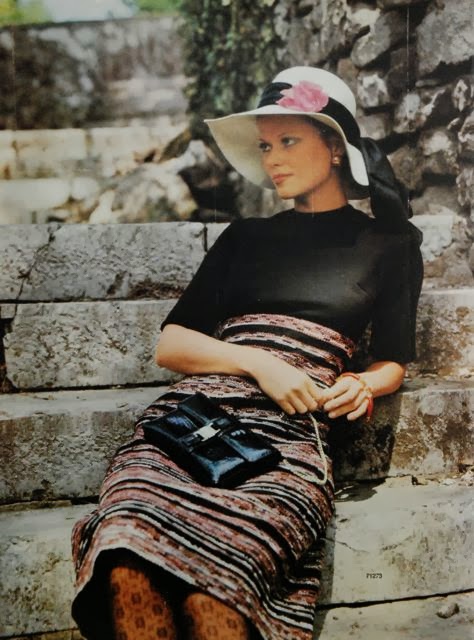
As you would expect, 1971 still looks pretty sixties in a mainstream magazine like this. If I only saw the picture of this suit, I'd date it a couple of years earlier.


Apparently, loud prints and weaves in bold colours were all the rage.


These two pairs are the only trousers in the magazine. The slight flares look like a shape I've worn a lot. I don't know about the outfit on the left but I would love to have those boots…
Oh, and the hooded dress is fun too.

Compared to the earlier Frohne publications I have, these designs are very nicely illustrated. Back in the 50's and early 60's, you would get just a couple of photographs (usually in black and white) and drawings of (often) mediocre quality for the rest. Clearly, printing techniques had improved over time and the reproduction of (colour) photographs was much cheaper in the 1970's than before.

February 4, 2014

The smallest yet

Just a couple of weeks ago, friends of ours welcomed their little daughter. We saw the parents-to-be a few days before she was born and they told us their little one was a bit small, but doing well. 
So, when it came to sewing up a gift for the new baby, I traced one of the smallest sizes from Knippie magazine for the first time (my nephew J was fairly large at birth and my sister had requested things for a couple of months later anyway).

This hooded jumper dress was shown in white faux fur with stretch but I thought it might work equally well in this grey cotton mix fleece. If I treated it to some extra cute-ness of course.
Kiddy-cute doesn't come naturally to me, but I really tried (and I know the parents well enough to trust that they won't want to dress their baby daughter exclusively in pastels). In this dress, I've topstitched every seam with a fairly close zigzag stitch in bright pink. And because it has a short button band and a big kangaroo pocket, there are quite a few bits of stitching.
We'll go and see them this weekend and I hope they'll like it.

February 2, 2014

Finally - that jeans post

Today, E took some pictures of me in my new jeans. I looked through the lot and I have to say this is one of those items which is really hard to photograph in a somewhat flattering way. And it doesn't help that I've been wearing them for two days and just decided to keep them out of the laundry basket so I could take these pictures...
To be honest, from the first moment I started drafting these trousers, I knew this wouldn't be a conventionally pretty garment. I was going more for quirky and kind of cool, than for looking as skinny and streamlined as possible.

Although they are hard to photograph, these trousers are supremely comfortable and I really like how they dress down rather formal items like my curvy tweed jacket (which pre-dates the blog, but hasn't been worn a lot because it was always hard to fit into my every day wardrobe). 

I've shown you the details, like the pockets and closure and those nice little points at the back before, so I hope you'll excuse from showing them again. I took pictures, but a combination of lighting issues and posing problems makes me really reluctant to show those.

Some people have asked me what I was going on about concerning the crotch angle. It is kind of hard to explain, so I made this drawing:

The black lines are the normal, fitted trouser sloper, the blue lines are a more relaxed with, with a slightly dropped crotch. The red lines are for these trousers. As you can see, the crotch is a bit lower than usual and the center front and back are flared out, to give some more ease and room for movement. 
A lower crotch can really limit the wearer's room for movement and this adaptation prevents that.

These trousers give plenty of room to move about. 
To be honest, if I hadn't been so impatient to start sewing, I would have gone for a little less extra room. This pair of trousers looks a bit funny if I stand with my legs really close together. But to be honest, how often do I stand like that?

And I'd like to add a little remark about washing fabric. I know a lot of people pre-wash every fabric before they sew it. I don't. I only do that if I have reason to suspect the fabric of shrinking badly. And contrary to its reputation, most jeans and/or denim you buy nowadays doesn't. In my experience, most modern twill-weave jeans will shrink about 5 percent at the very most, which is reduced to about 2 percent (also at most) after ironing. 
The big advantage of washing your new jeans for the first time after sewing is the way the fabric will develop. You know that signature bobbled bleach effect RTW jeans has, especially at the flat felled seams? You don't get that if you pre-wash. It's caused by warping of the fabric when it is washed for the first time after it was sewn.
And there's another thing: regardless of when you was for the first time, any jeans fabric which is just a bit too firm and stiff can be softened up by washing it with a double dose of fabric softener. This will both wash out the starch (a lot of fabrics are lightly starched during weaving) and soften up the fibres. It worked really well for these trousers.

January 31, 2014

Requiem for a coat

There is no point in denying it anymore: My favorite coat is dying.
I made it way back in November 2009, in the first year I had this blog. As such, it was one of the earliest projects to receive the full blogging treatment with posts about the plans for it, the muslin, the construction and the final result (weirdly, that construction posts still gets a lot of hits. Probably by people who googled 'sewing secrets'…).
And ever since, it has been my most worn winter coat.


While the fabric is not particularly thick and warm, the shape really makes up for that. The loose body with the deep-set sleeves allows me to wear just about  anything under it. The generous overlap and tapered body and sleeves are great for keeping out the chill and that small V-neck can quite easily and efficiently be closed off with a scarf.
Its length makes it ideal for both cycling and driving.
And it looks great with any trouser shape I ever wear and with slim skirts as well.


Over a year ago, I already noticed the pilling of the fabric (a rather loosely woven herringbone tweed, so it was never going to be the most durable) in some places. However, I ignored it, deciding that it's OK for tweed to look a bit rough.


I also noticed how the points of the collar were getting bent. It's no surprise really, I cycled a lot in this coat and when I stretch my arms forward, I push against those tips of the collar.
And than, the pocket welts started to sag just the tiniest bit, and the bottom edge was really the only mistake I made with the pattern. It should have been a tiny bit wider and have a hidden closure. Now, with more and more wear, it was showing more and more.
And then, at the beginning of this winter, I noticed a big tear in the lining. I've a new lining for E's coat once but that still looked fine on the outside. It seemed like to much trouble for coat which was, if I was honest, already on the way out.
And yet, I kept wearing it.
For all the practical reasons but also because I've just grown very fond of this coat. I was the first wide, loose coat I made and even one of the first loose garments. A real change in silhouette, a diversification really. 
It just suits me. It's a coat like a warm embrace. A hug and a place to hide when I'm feeling low. A protective cocoon and a statement of confidence at the same time.
I guess I'm writing all this to convince myself it really is time to say goodbye. I have coat fabrics in my stash, and some ideas of what to do with them, but it doesn't feel like any of those could replace my great friend of the garment kind...

January 28, 2014

New old patterns!

I've been collecting vintage sewing and fashion stuff for a while. I've found and bought Dutch ladies' magazines, French fashion magazines and sewing magazines without and with patterns on tracing sheets from the Netherlands, Belgium, France, Germany and England (all from Dutch sellers, and most likely bought here back in their day).
And all that time, vintage envelope patterns seemed to be pretty much non-existent here in the Netherlands. Sometimes, someone would sell a couple in English, McCall's and the like. On rare occasions, you would find a few of the patterns which could be ordered from ladies' magazines like Libelle or Margriet or fashion/sewing magazines like la Femme Elegante (wh ich was originally French but also published in a Dutch version).

In fact, it had been quite a while since I had even browsed Marktplaats (a Dutch Ebay version). But a few days ago, I was tired and it seemed like a nice distraction. And this time, I found something I hadn't come across before: Dutch envelope patterns. 
Not one, but two different sellers were selling patterns by the previously unknown-to-me company Harmien's. One offered a single lot of three patterns in size 42 and identified them as 1940's. The other had more patterns on offer and had put up each design separately. And she had different sizes: 38, 40 and 42. She didn't mention the era but the designs looked late 1940's, early 1950's to me. And the packaging was exactly the same as in the first lot.

I know from my magazines from that period that I would probably be a size 38, so that was the size I went for.
My seven lovely new vintage patterns arrived in the mail today.

Just look at them:

A lovely shirt dress with interesting yokes,

And this one, with the wider surplice bodice and a full skirt.

One with a slim skirt with stand-out pockets and a lovely collar. This design was also in the three pattern lot which was sold and 1940's

A dress with a pleated skirt with an interesting overlapping tab waistband.

And this stunner with gathers at the bust and along the center front.

I had almost passed over this one but it has a feature I'm interested in: a pleat in the skirt, right at the bottom of the front closure. It's a fairly common feature in designs of the era and I'd like to know what it looks like on the pattern.

And finally, my favorite. I just love the complex skirt, the asymmetrical closure, the collar and that deep neckline filled up by a shirt front.

There are no dates on any of these patterns, just pattern numbers. I stick with my previous dating though. The shoulders are modest and sloped down compared to any mid-1940's fashion drawings I've ever seen and the fairly long and modestly wide skirts would fit in with the notion of post-New Look beauty but the restriction of expensive or rationed fabric.
All patterns are still in the old plastic, so as I already expected from their grouping on the site, I'm pretty sure they are deadstock.

At the back of each envelope, there's a short text which explains the design and  tells you how much fabric you need.
And in fact, these are not really envelopes at all: the tops and bottoms of the wrappers are open. Printed on their insides, there is a very limited explanation about the use of the patterns.

The patterns themselves are unprinted and clearly in their original folds.
I would have liked to have instructions for a change and it's a bit weird there isn't even a sizing chart (maybe you could also order these patterns from a magazine which included that) but I'm still thrilled with these.

January 27, 2014

Intermezzo

Early this morning, I finished the striped sweater but I haven't found a photo-opportunity for it or the new jeans yet… I'll come back to that later.

I've been thinking about things I want to make for the remainder of this winter and about new things to do here, on my blog. However, I don't feel like discussing half-developed plans right now. 

Right now, I'd like to take you on a bit of a detour.
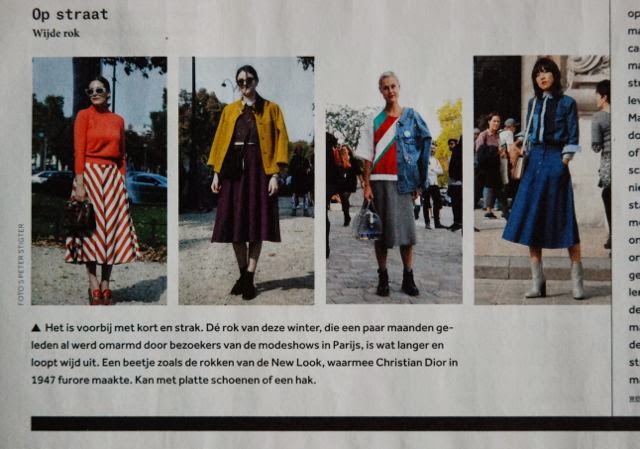
In the magazine that comes with my newspaper on Saturday (Volkskrant magazine nr. 676, 25 January 2014), there's always a little corner with a report on a street style trend, and this one stood out to me:

Longer, wider skirts. Apparently these ladies were visitors to fashion shows in Paris a couple of months ago, so they are not your common girls in the street. Still, I kind of like it when a personal fashion interest of mine intersects with a mainstream or high fashion trend. 
I love the boldly striped skirt and the colour combo in the second picture. Oh, and I want to go off and make a denim half circle skirt RIGHT NOW.

What is funny to me is that the text makes a reference to Dior's New Look. That is right when you only look at the lengthening skirts but not when you look at the complete silhouette. These ladies largely stick to the usual rather straight mainstream fashion silhouette. If I wear a long-ish wide skirt, I make and style it to show off hip-to-waist ratio, like women used to do.
Of course, it is nice to see different options.

Do you like big skirts? And what do you think of this modern styling of them?

January 25, 2014

A bit of jeans

Yesterday, I managed to take some pictures of my new pair of jeans. Unfortunately, I must be out of practice when it comes to taking self-timer images: all of those came out blurry.
So, I'll do things differently this time and show you the details of my new jeans in this post and the whole 'look' in a later one. I hope you'll approve ;)

For this pair of jeans, I used fairly coarse black denim and decided to use the wrong side of the fabric for pocket details.

At the front, I made single welt pockets with wide welts which fall over the pocket opening (like you often see on coats). They end in the side seams.

At the back, there are patch pockets which I hemmed to the outside so they also show the wrong side of the fabric. In this picture, you can also see the detail of the points at center back. I really like how that turned out.

As you may have noticed in the pictures above, these trousers don't have a waistband. And I didn't make a normal fly. 
The button closure looks (I thought about making bound buttonholes but didn't feel like all that extra work for what was, after all, just an experiment), on the outside, like the one you would make on a dress. On the inside, I gave it an extra overlap for added security. Waistline and button front facing were, of course cut in one piece and cover the top of the pocket bags.

And this is the unusual shape experiment I mentioned before:

On the left is an old pair of jeans which I made based on my pattern for belt-pleated trousers, on the right is the new pair.
As you can see, with both laid down as flatly as possible, the legs of the new pair are at a much wider angle. This means there is more fabric in the lower hip and inner thigh area. If a pair of trousers has the crotch in its classic place, where the wearer's legs meet, that would be redundant and unflattering. However, there we've seen lots of trendy jeans with a lower hanging crotch these past years and I have made some trousers with a very mild version of that effect. In that case, this change in angle provides some welcome extra room for movement. I'm not sure but I think I have seen men's trendy jeans which must be shaped like this.

Hopefully, I'll manage to take some more pictures tomorrow so I can show you how these jeans look when I wear them.