And this, finally, is the last finished item I mentioned earlier. I took the pictures at the same time as those for my skirt but I wanted to be able to tell you how to make something like this.
I designed and drafted the pattern for this top but it's that actually was a long time ago. Its first version was way back in 2011 and that one is still in my wardrobe. There as also a short-sleeved dress version which I can't find right now and a summer top in 2013 which was the first one with the neckline treatment I've just used again.
Please don't mind the weird facial expression or the blurriness of the picture, but I enlarged this bit to properly show you the top (E didn't take any pictures closer up).
This new one was made from some jersey with knitted-in vertical stripes in alternating widths. With my orange skirt, I wore it tucked in but it also looks good over a normal pair of jeans (I wanted to take a picture of that yesterday but time and daylight didn't allow it).
When I first started to make twisted tops, I used the Pattern Magic instructions (even before I owned the book myself). By now, I'm so used to the technique that I don't even look at those anymore I think I have make a bit of an own way. And the rest of this top obviously bears little resemblance to the version made from the Japanese sloper.
In fact, I'm not even sure this should technically be called a twist-top. The principle is quite simple: Two pieces of fabric looped through each other.
I've tried to illustrate it with these two scarves. If you made a top like this by draping, you would probably start like this.
In the popular Burda version of a twist top, only the sides I've sort of folded together here are sewn closed and there's a separate lower body piece. In the Pattern Magic version and in most of mine, the bottom of the top is in one piece with the twisted part.
One of my personal twists to this design is the shoulder line: the dropped shoulder adds room in the upper bodice which always works well if you have a fairly small bust size.
In fact, this post is already getting a bit long so I think I'll stop for today. So, stay tuned for tomorrow's pattern tutorial!
February 11, 2015
February 8, 2015
Skirt and bolero
And here are the skirt and bolero I mentioned earlier!
The skirt took a bit longer. Sleek pencil skirts are great, but only if they fit well. And the more sewing experience you get, the more critical you will become. In this case, I decided to re-work my skirt sloper because I thought it was responsible for some of my issues for a former favorite skirt. Turns out that it was. For some reason, I had never made a test version of that sloper with a zipper... So I had never been able to see an issue at the back: Apparently, I have a bit of a saggy behind... Or at least, the maximum fullness there is at the height of the lower hip while in the standard shape assumed by drafting system, it starts higher up. This is why I always have to lengthen the darts half-way through construction when I'm using this shape...
And in my trouser sloper, I made an adjustment for this lack of volume at the top of the bottom years ago
To put it simply: I kind of knew, so what took me so long to fix it?
Anyway, I did so now and I made a skirt.
The skirt is made from some I-can't-believe-it's-not-wool orange fabric from my stash. The seller was sure it was cotton and it shrunk like old-fashioned twill weave cotton when washed. It has a twill weave and a slightly plush texture and a very intense orange colour. It's also rather thick.
Because of that, I didn't want to make a kick pleat at the back, which is usually my preferred way of adding a bit of leg-room to a narrow skirt. I'm not a huge fan of vents and slits (basically, I think only vents with a considerable overlap look good and then I would still have quite a pile of fabric at center back).
Instead, I took a clue from my vintage patterns: Just about every vintage pattern for a pencil skirt in my collection doesn't actually have straight sides. Let alone tapered ones. The vast majority of narrow skirts from the late 1940's and 1950's actually has a slight A-line. Usually, a back pleat is still added to allow for ease of movement, but still.
In this case, I went with just the slight A-line. For walking, I thought it was OK, but you never really know until you go outside in it. It forces me to take slightly shorter steps, but it's not a real problem.
I'm still happy I didn't make it wider though. Now, it looks really sleek. A couple more centimeters at the hemline and the A-line effect would have been more obvious.
To make the skirt a bit more interesting, I added pockets at the front. I considered single welts but ended up making patch pockets without topstitching (tutorial for those is here).
Oh, and obviously it is lined.
I suppose I've become a bit addicted to bright skirts over the past few years... At least I'm happy to add this one to my wardrobe.
The bolero was just a quick fix, a tried-and-tested (and self-drafted) pattern made up in that same tweed-y grey mystery knit which I've used for my experimental dress and E's cardigan. I've made it twice before: The first one was a real wardrobe staple so when, after years of service, the cuffs started to fray, I made another one. That one was made from a viscose knit which was had been on the same sale as this grey stuff. It was very nice to wear but, unfortunately, also extremely fragile. Any snag would tear a whole into it. That bolero didn't survive for more than a couple of days. So, now I have this one.
It's a very simple pattern: Just one pattern piece plus cuffs and that long binding along the edge. It takes just minutes to make on the overlocker/serger.The skirt took a bit longer. Sleek pencil skirts are great, but only if they fit well. And the more sewing experience you get, the more critical you will become. In this case, I decided to re-work my skirt sloper because I thought it was responsible for some of my issues for a former favorite skirt. Turns out that it was. For some reason, I had never made a test version of that sloper with a zipper... So I had never been able to see an issue at the back: Apparently, I have a bit of a saggy behind... Or at least, the maximum fullness there is at the height of the lower hip while in the standard shape assumed by drafting system, it starts higher up. This is why I always have to lengthen the darts half-way through construction when I'm using this shape...
And in my trouser sloper, I made an adjustment for this lack of volume at the top of the bottom years ago
To put it simply: I kind of knew, so what took me so long to fix it?
Anyway, I did so now and I made a skirt.
The skirt is made from some I-can't-believe-it's-not-wool orange fabric from my stash. The seller was sure it was cotton and it shrunk like old-fashioned twill weave cotton when washed. It has a twill weave and a slightly plush texture and a very intense orange colour. It's also rather thick.
Because of that, I didn't want to make a kick pleat at the back, which is usually my preferred way of adding a bit of leg-room to a narrow skirt. I'm not a huge fan of vents and slits (basically, I think only vents with a considerable overlap look good and then I would still have quite a pile of fabric at center back).
Instead, I took a clue from my vintage patterns: Just about every vintage pattern for a pencil skirt in my collection doesn't actually have straight sides. Let alone tapered ones. The vast majority of narrow skirts from the late 1940's and 1950's actually has a slight A-line. Usually, a back pleat is still added to allow for ease of movement, but still.
In this case, I went with just the slight A-line. For walking, I thought it was OK, but you never really know until you go outside in it. It forces me to take slightly shorter steps, but it's not a real problem.
I'm still happy I didn't make it wider though. Now, it looks really sleek. A couple more centimeters at the hemline and the A-line effect would have been more obvious.
To make the skirt a bit more interesting, I added pockets at the front. I considered single welts but ended up making patch pockets without topstitching (tutorial for those is here).
Oh, and obviously it is lined.
I suppose I've become a bit addicted to bright skirts over the past few years... At least I'm happy to add this one to my wardrobe.
February 4, 2015
Those slips...
To be honest, I had my doubts about modeling these here... Slips are underwear after all.
On the other hand, this is the first time I've made slips, I've mentioned them a couple of time already and there was some discussion about slips on the We Sew Retro Facebook group recently.
Well eh... here we go! As you may know, I have, over the past years, made several dresses in thicker cottons and with longer-than-short sleeves. Dresses which can be worn in autumn and in spring and on warmer winter days. If I wear tights or stockings under them, that is. And that, obviously, is the problem. Just about every fabric can stick to hosiery.
Last year, I made a very plain half-slip for that purpose: A bias cut polyester with an elastic waistband. It sort of did the trick. It just suffered a bit too much from static cling (to the stockings, not to the dresses) and it taught me that I don't like wearing half slips. It's another line at the waist. With the dress's waist seam, the belt and the top edge of a garter belt or pantyhose already in place there, that's just one too many.
So, last week, I finally bit the bullet and made myself some slips. I thought about the versions I've seen on other blogs: luscious vintage style bias cut silk numbers, playful little things with lacey edges etc.
And I thought about what I wanted from these slips: A slippery layer between skirt and stockings which won't show under my dress and won't bother me in any way. It's an extra layer which will be worn over various kinds of bras.
With those requirements in mind, it was obvious that fussy styles were not going to work. I decided to use my body fashion block. A sloper intended for things like swimsuits. I added some ease to it (this sloper has serious negative ease, so reduced that a bit) and a skirt. Because I wasn't quite sure about the shape, I first made a slip using as basic a shape as possible. I used a grey lycra with a shiny stripe which I bought cheaply last year with this purpose in mind.
This one. It proves that the pattern works but I really should have made the neckline a bit deeper. This won't work under most of my dresses.
So, I made a spaghetti strap version. I wish I could have used the narrow bits of the scallops at the tops of bodice but I didn't have enough of it to get the piecing right for that. Because I sometimes have issues with shoulder straps slipping off, I crossed them at the back.
And then, I made a third slip. This one is to wear with full skirted dresses. The top is the same as the previous one. Below the waist, I let it flare out a bit more until 12 cm lower. The skirt is a half circle of lining material, it's 'waistline' is the measurement at that spot plus some ease. The top is stretched to fit the skirt while serging it on.
All the slips are hemmed using the rolled hem setting on the serger. It took some fiddling to find a setting which would work with the stretchy lycra but once I did, it made for a clean and easy finish.
The lace on the grey slips was sewn on from the top (and I cut away the lycra under it later), on the black one it's inserted and the sides and back are finished with fold-over elastic. The spaghetti straps are bra strap elastic from my stash.
I think these will work, but I have yet to try it out.
And I hope this post may add some food for thought or some motivation for other people who are considering sewing slips.
In which case I should add a few notes: These were really quick and simple to make because I have a serger and am used to sewing stretchy material with it. I've also made lingerie before so lycra and lace have no particular secrets for me. If this doesn't count for you, my 'easy fix' won't be yours.
When planning your slip, consider what you want from it and your sewing equipment, skills and experience.
On the other hand, this is the first time I've made slips, I've mentioned them a couple of time already and there was some discussion about slips on the We Sew Retro Facebook group recently.
Well eh... here we go! As you may know, I have, over the past years, made several dresses in thicker cottons and with longer-than-short sleeves. Dresses which can be worn in autumn and in spring and on warmer winter days. If I wear tights or stockings under them, that is. And that, obviously, is the problem. Just about every fabric can stick to hosiery.
Last year, I made a very plain half-slip for that purpose: A bias cut polyester with an elastic waistband. It sort of did the trick. It just suffered a bit too much from static cling (to the stockings, not to the dresses) and it taught me that I don't like wearing half slips. It's another line at the waist. With the dress's waist seam, the belt and the top edge of a garter belt or pantyhose already in place there, that's just one too many.
So, last week, I finally bit the bullet and made myself some slips. I thought about the versions I've seen on other blogs: luscious vintage style bias cut silk numbers, playful little things with lacey edges etc.
And I thought about what I wanted from these slips: A slippery layer between skirt and stockings which won't show under my dress and won't bother me in any way. It's an extra layer which will be worn over various kinds of bras.
With those requirements in mind, it was obvious that fussy styles were not going to work. I decided to use my body fashion block. A sloper intended for things like swimsuits. I added some ease to it (this sloper has serious negative ease, so reduced that a bit) and a skirt. Because I wasn't quite sure about the shape, I first made a slip using as basic a shape as possible. I used a grey lycra with a shiny stripe which I bought cheaply last year with this purpose in mind.
This one. It proves that the pattern works but I really should have made the neckline a bit deeper. This won't work under most of my dresses.
So, I made a spaghetti strap version. I wish I could have used the narrow bits of the scallops at the tops of bodice but I didn't have enough of it to get the piecing right for that. Because I sometimes have issues with shoulder straps slipping off, I crossed them at the back.
And then, I made a third slip. This one is to wear with full skirted dresses. The top is the same as the previous one. Below the waist, I let it flare out a bit more until 12 cm lower. The skirt is a half circle of lining material, it's 'waistline' is the measurement at that spot plus some ease. The top is stretched to fit the skirt while serging it on.
All the slips are hemmed using the rolled hem setting on the serger. It took some fiddling to find a setting which would work with the stretchy lycra but once I did, it made for a clean and easy finish.
The lace on the grey slips was sewn on from the top (and I cut away the lycra under it later), on the black one it's inserted and the sides and back are finished with fold-over elastic. The spaghetti straps are bra strap elastic from my stash.
I think these will work, but I have yet to try it out.
And I hope this post may add some food for thought or some motivation for other people who are considering sewing slips.
In which case I should add a few notes: These were really quick and simple to make because I have a serger and am used to sewing stretchy material with it. I've also made lingerie before so lycra and lace have no particular secrets for me. If this doesn't count for you, my 'easy fix' won't be yours.
When planning your slip, consider what you want from it and your sewing equipment, skills and experience.
February 2, 2015
Jardin de la Mode
Slips, a skirt, a bolero and a twist-top... I've got quite a few items to show you but I haven't got any pictures yet. This past weekend, that pesky cold was still bothering me so I didn't feel like modeling and I only put the finishing touches on the skirt and top today (a button and hemming).
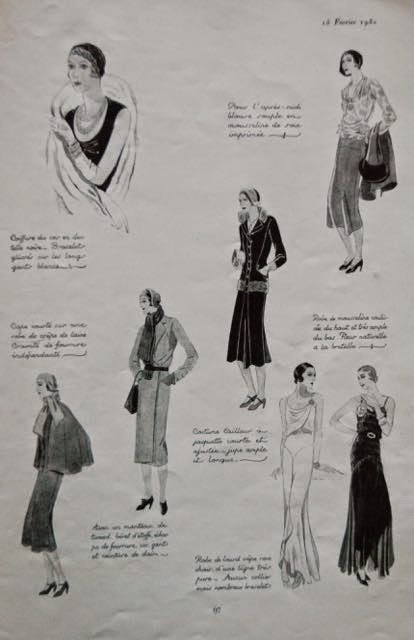
So, I thought I might share some more eye-candy with you: This time images from the French fashion magazine Jardin de la Mode from February 1930.
There's fashion news,
hats,
new styles for spring, arranged by fabric type,
and gorgeous dresses by Patou,
Lanvin
and Abernard (never heard of that one...)
and even a section on what the fashionable ladies in Paris are wearing.
So, I thought I might share some more eye-candy with you: This time images from the French fashion magazine Jardin de la Mode from February 1930.
There's fashion news,
hats,
new styles for spring, arranged by fabric type,
and gorgeous dresses by Patou,
Lanvin
and Abernard (never heard of that one...)
and even a section on what the fashionable ladies in Paris are wearing.
January 30, 2015
The ladies' world
This week, I'm having a bit of a cold so sewing is slow and there's no way I'm modeling slips.
I'm also kind of second-guessing my plans for a 1920's dress in that raspberry pink wool crepe... After all, how much winter do we really have left? (to be honest, these are the Netherlands so unpredictability in the weather is a certainty. We haven't had much of a winter so far so that might mean a mild and early spring. Or we could get a brutally cold February. The forecasts don't say so but they've been wrong before...)
And this week, my patterns from EvaDress (bought with the prize from last year's Vintage Sewing Pattern Pledge) arrived. They took so long, I was starting to get worried but that's international shipping for you, I guess...
But I'm very glad they're here and I'm considering fabric options for these wonderful designs. Both seem to want crepe or rayon... Not the most plentiful things in my stash (I guess that is a reason in itself to keep coming back to 1950's: Those styles sew up well in cheap fabrics like cotton).
I am definitely planning to sew these up as part of this year's Vintage Sewing Pattern Pledge!
In the mean time, I thought I'd share a recent vintage magazine find with you. I'm particularly happy with this one. It's perfect for a pattern geek like me:
These were advertised with rather limited information. All that was told was that they were bound copies of ladies' fashion magazines from 1948 and 1949. Knowing that there were no real Dutch fashion magazines in those days, I emailed the seller to inquire. The answer really pleased me: This was a magazine targeted at sewing teachers and professional seamstresses!
It's called de Dameswereld (which translates as "the Ladies' World") and it was also the official magazine for the association of sewing teachers.
And it has a bit of everything:
A complicated pattern explained in each issue. I love both these dresses!
Loads of information about measuring and how to use their system of slopers. I think I bought the basic book about those a year or two ago...
Hard-core sewing and tailoring instruction. This page is about ladies' collars.
Fashion news. This pages highlights robes and nightgowns (described as lingerie) presented at a trade show in London.
And there is information about things like fashion shows and the exact rules of the textile rationing system (in place in the Netherlands, like in the UK, until 1950). And some industry-related advertising for fabric, thread and sewing machines.
I don't think this would have been a star find for everyone who's looking for vintage patterns but it certainly is for me. I may just make one of the explained patterns for the Vintage Sewing Pattern Pledge as well...
I'm also kind of second-guessing my plans for a 1920's dress in that raspberry pink wool crepe... After all, how much winter do we really have left? (to be honest, these are the Netherlands so unpredictability in the weather is a certainty. We haven't had much of a winter so far so that might mean a mild and early spring. Or we could get a brutally cold February. The forecasts don't say so but they've been wrong before...)
And this week, my patterns from EvaDress (bought with the prize from last year's Vintage Sewing Pattern Pledge) arrived. They took so long, I was starting to get worried but that's international shipping for you, I guess...
But I'm very glad they're here and I'm considering fabric options for these wonderful designs. Both seem to want crepe or rayon... Not the most plentiful things in my stash (I guess that is a reason in itself to keep coming back to 1950's: Those styles sew up well in cheap fabrics like cotton).
I am definitely planning to sew these up as part of this year's Vintage Sewing Pattern Pledge!
In the mean time, I thought I'd share a recent vintage magazine find with you. I'm particularly happy with this one. It's perfect for a pattern geek like me:
These were advertised with rather limited information. All that was told was that they were bound copies of ladies' fashion magazines from 1948 and 1949. Knowing that there were no real Dutch fashion magazines in those days, I emailed the seller to inquire. The answer really pleased me: This was a magazine targeted at sewing teachers and professional seamstresses!
It's called de Dameswereld (which translates as "the Ladies' World") and it was also the official magazine for the association of sewing teachers.
And it has a bit of everything:
A complicated pattern explained in each issue. I love both these dresses!
Loads of information about measuring and how to use their system of slopers. I think I bought the basic book about those a year or two ago...
Hard-core sewing and tailoring instruction. This page is about ladies' collars.
Fashion news. This pages highlights robes and nightgowns (described as lingerie) presented at a trade show in London.
And there is information about things like fashion shows and the exact rules of the textile rationing system (in place in the Netherlands, like in the UK, until 1950). And some industry-related advertising for fabric, thread and sewing machines.
I don't think this would have been a star find for everyone who's looking for vintage patterns but it certainly is for me. I may just make one of the explained patterns for the Vintage Sewing Pattern Pledge as well...
January 28, 2015
Experimenting
You know I draft most of the patterns for just about anything I make. And you know I'm fond of special pattern making tricks, like those in the Pattern Magic books. And of 'object' garments (like this Burdastyle cardigan, these retro designs from Studio Faro and several of my own creations, some of which I made tutorials for which are in the list on the right of this page).
Well, I often combine all those likes and loves and experiment. Especially if I have just found a lot of appropriate fabric, cheaply. In this case, I was already eyeing up the tweed-y knit I used for E's cardigan. I could make something like a knitted 1950's suit from that stuff. Or a dress.
And then, I suddenly decided to make this:
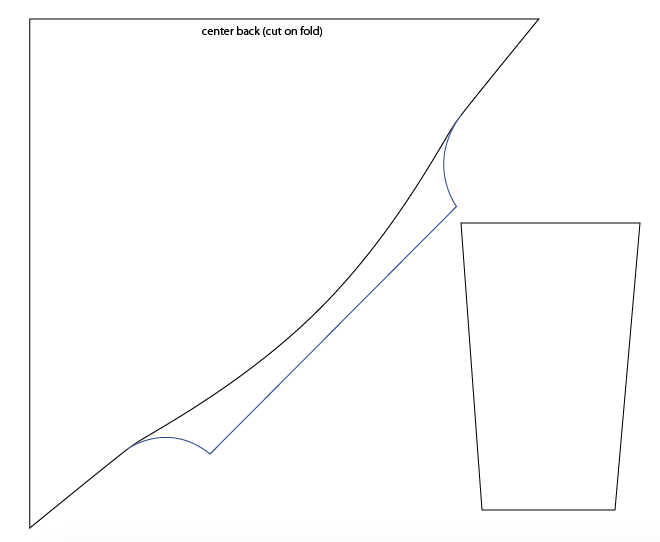
These are the bodice pattern pieces (none of these drawings are to scale).
And this is the dress. It came out looking (even) more 1950's than I had expected. Not that I'm complaining though.
These are not the prettiest pictures. Most days are pretty glum and cloudy these past weeks and I had been wearing the dress for more than a day before it was light enough for photographs (that and the high heels are why the back looks so folded). However, they're good enough to do what I really needed from them: Just show the dress.
And of course, arm room is an issue. This is as far as it will go without seriously pulling the whole dress up.
It doesn't make the dress completely unwearable but it leaves considerable room for improvement.
There are several options for change, depending on where I want to go with the design.
- It would be possible to cut an armscye in the one-piece bodice and use a more normal sleeve. In that case, it would make sense to also adapt the bodice under the sleeve and make it more of a normal bodice and less of an object there. I've drawn this particular sleeve with a point because I think that would work well with the shape of the collar. All this would make the whole look more 1950's and less Japanese.
- Another option would be to make the 'object' bodice larger on all sides and mount it over a fitted lining of a thinner fabric (lycra, for example). In that way it would blouse over the sleeves and skirt which should allow for a wider range of movement. This would emphasize the free-form look.
- Related to the previous option, I could also treat the entire 'object' bodice as a capelet instead of a bodice. Again, over a thin and smooth lining, probably connected at the shoulders. Depending on the proportions and the styling of the skirt, this could look either Pattern Magic-esk or almost 1930's.
- Going back to the basic shape the dress has now, the least invasive thing to do to it would be to insert underarm gussets. This would work and it would still look fairly 1950's. I just really don't like the mess of seams you'd get at the sides.
- Of course, with this shape of the bodice, the arm-room issue could also be solved by adding room at the top of the arm and shifting the sleeve up. That would mean making a shoulder seam and flaring it up from the shoulder point (the long red line in the picture would be the seam, the small wedge would have to be added to each side, but I thought adding two might make the drawing more confusing). It would work but these seams would meet in a single point at the back of the neck. Which doesn't work with the cut-on facing I've been using and I don't really like that look anyway.
- Building on the idea of adding room at the top of the arm, I could consider adding a gusset there.
- And because that would mean attaching the sleeve to the area where the gusset is, wouldn't it be better to integrate those two?
- And because the sleeve is closely fitted, it might be better to shape both pieces so they can be made to properly encircle the arm.
I had some other ideas somewhere along the line, like one involving a side panel for the the bodice which would extend into the underarm gusset, but I think these were the main ones. I think I like the first and last idea best, depending on how vintage or modern I want the end result to look.
Oh, and there is one other, important alteration which I am considering for those styles which should not look very 1950's: In the design sketch, the diamond shape of the 'object' bodice is much more pronounced than in the actual dress. I would like to be able to make my creation look like that.
It doesn't because I've mixed pattern shapes for loose, free-hanging shapes with pieces of a fitted design.
If I want the dress to look like the drawing, I should make an alteration like this, which will add extra material to follow the skirt to my sides. And of course, any alteration I make to the shoulder (apart from those where I also want to change the bodice under the arm) can than be applied to this shape.
I haven't made any of these alterations yet, but I'm sure I'll try my favorites. And I thought you might like this little look into how my mind works with these things.
Well, I often combine all those likes and loves and experiment. Especially if I have just found a lot of appropriate fabric, cheaply. In this case, I was already eyeing up the tweed-y knit I used for E's cardigan. I could make something like a knitted 1950's suit from that stuff. Or a dress.
And then, I suddenly decided to make this:
I've always loved the neckline/collar thing you get in Pattern Magic's "Wearing a square" and in the those 'object' retro tops... What if I tried to combine that with normal pattern making for jersey fabrics? I had considered a design like this before but at that time, I didn't want to risk it because I couldn't figure out how to make sure it wouldn't be too confining for arm movement.
This time, I decided to just go for it and worry about practicality later.These are the bodice pattern pieces (none of these drawings are to scale).
And this is the dress. It came out looking (even) more 1950's than I had expected. Not that I'm complaining though.
These are not the prettiest pictures. Most days are pretty glum and cloudy these past weeks and I had been wearing the dress for more than a day before it was light enough for photographs (that and the high heels are why the back looks so folded). However, they're good enough to do what I really needed from them: Just show the dress.
And of course, arm room is an issue. This is as far as it will go without seriously pulling the whole dress up.
It doesn't make the dress completely unwearable but it leaves considerable room for improvement.
There are several options for change, depending on where I want to go with the design.
- It would be possible to cut an armscye in the one-piece bodice and use a more normal sleeve. In that case, it would make sense to also adapt the bodice under the sleeve and make it more of a normal bodice and less of an object there. I've drawn this particular sleeve with a point because I think that would work well with the shape of the collar. All this would make the whole look more 1950's and less Japanese.
- Another option would be to make the 'object' bodice larger on all sides and mount it over a fitted lining of a thinner fabric (lycra, for example). In that way it would blouse over the sleeves and skirt which should allow for a wider range of movement. This would emphasize the free-form look.
- Related to the previous option, I could also treat the entire 'object' bodice as a capelet instead of a bodice. Again, over a thin and smooth lining, probably connected at the shoulders. Depending on the proportions and the styling of the skirt, this could look either Pattern Magic-esk or almost 1930's.
- Going back to the basic shape the dress has now, the least invasive thing to do to it would be to insert underarm gussets. This would work and it would still look fairly 1950's. I just really don't like the mess of seams you'd get at the sides.
- Of course, with this shape of the bodice, the arm-room issue could also be solved by adding room at the top of the arm and shifting the sleeve up. That would mean making a shoulder seam and flaring it up from the shoulder point (the long red line in the picture would be the seam, the small wedge would have to be added to each side, but I thought adding two might make the drawing more confusing). It would work but these seams would meet in a single point at the back of the neck. Which doesn't work with the cut-on facing I've been using and I don't really like that look anyway.
- Building on the idea of adding room at the top of the arm, I could consider adding a gusset there.
- And because that would mean attaching the sleeve to the area where the gusset is, wouldn't it be better to integrate those two?
- And because the sleeve is closely fitted, it might be better to shape both pieces so they can be made to properly encircle the arm.
I had some other ideas somewhere along the line, like one involving a side panel for the the bodice which would extend into the underarm gusset, but I think these were the main ones. I think I like the first and last idea best, depending on how vintage or modern I want the end result to look.
Oh, and there is one other, important alteration which I am considering for those styles which should not look very 1950's: In the design sketch, the diamond shape of the 'object' bodice is much more pronounced than in the actual dress. I would like to be able to make my creation look like that.
It doesn't because I've mixed pattern shapes for loose, free-hanging shapes with pieces of a fitted design.
If I want the dress to look like the drawing, I should make an alteration like this, which will add extra material to follow the skirt to my sides. And of course, any alteration I make to the shoulder (apart from those where I also want to change the bodice under the arm) can than be applied to this shape.
I haven't made any of these alterations yet, but I'm sure I'll try my favorites. And I thought you might like this little look into how my mind works with these things.
Subscribe to:
Posts (Atom)